Scripture Reading: John 2-4
Across Galilee’s villages and Judea’s hills, Christ moved with deliberate tenderness, weaving a thread that drew worship from ceremony toward communion. At a wedding feast, He transformed water meant for cleansing into wine that symbolized covenant joy. In a midnight conversation, He spoke of birth beyond biology and faith beyond ritual. And by a well in Samaria, He revealed that divine belonging no longer depends on bloodline or geography but on the Spirit’s indwelling. Every encounter restored what centuries of separation had broken—the true posture of worship before a living God.
Revelation – John 2
The first sign in John’s Gospel unfolds in Cana of Galilee (John 2:1–2), where the simplicity of a village wedding becomes the stage for divine disclosure, and though the moment appears ordinary, every detail carries prophetic weight because marriage in Israel had long stood as a living emblem of covenant union (Isaiah 62:4–5; Hosea 2:19–20). At this feast, where joy was expected to overflow, the wine runs out, and that emptiness reflects the nation’s spiritual drought, for generations had awaited the renewal promised by the prophets who spoke of a day when mountains would drip with sweet wine and the streams of Judah would flow again (Amos 9:13–14; Joel 3:18). Into this moment of human lack, the Messiah steps forward to reveal that divine abundance does not depend on human supply.
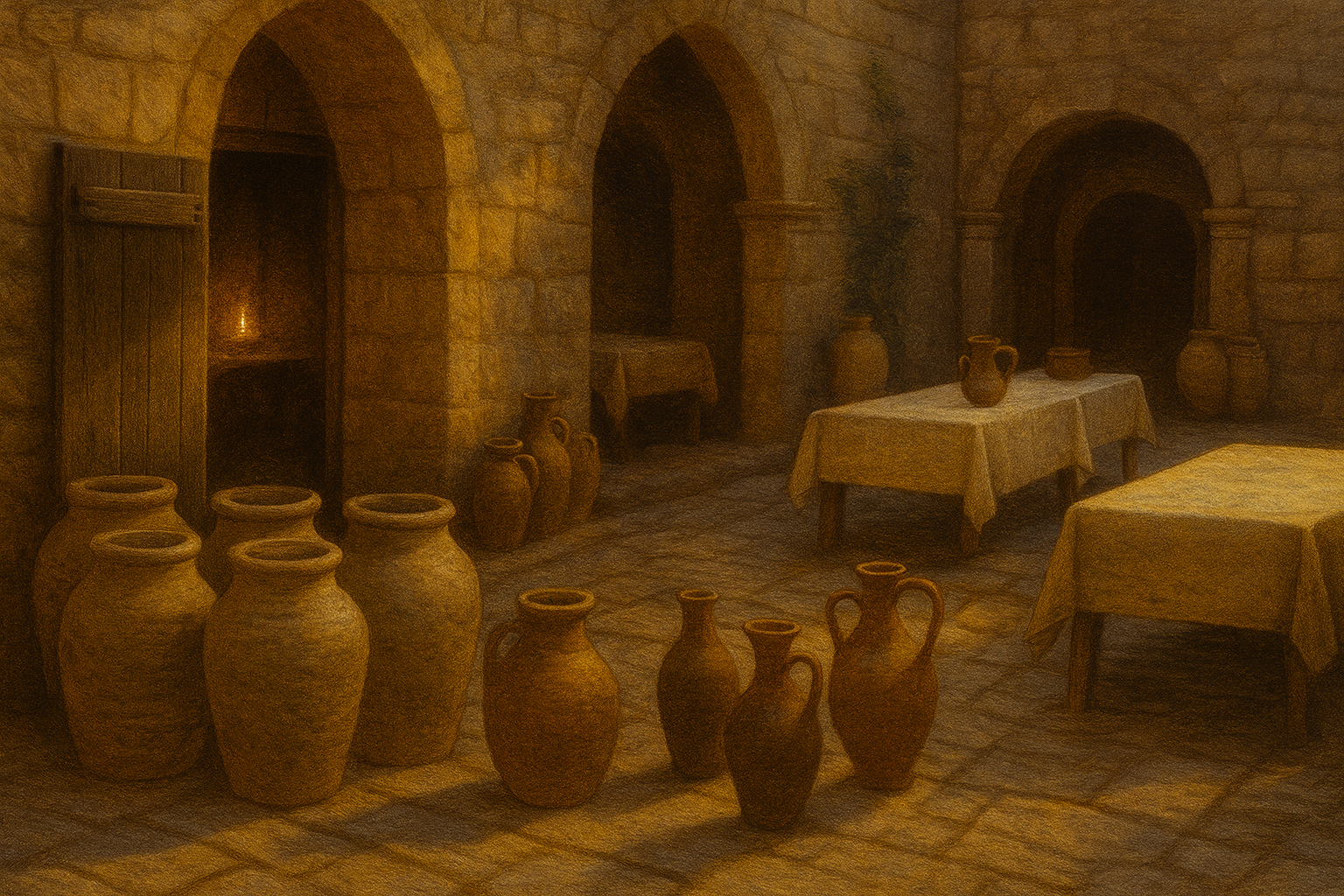
When His mother speaks of the need, her words carry centuries of longing, and though His answer (John 2:3-4) announces that every act will unfold according to divine timing, His compassion directs Him toward action that manifests mercy before judgment. He instructs the servants to fill six stone jars used for purification (John 2:6), and as they obey, the scene begins to shift from ceremony to revelation, for those vessels had long symbolized a covenant dependent on continual washing. In transforming the water within them into wine, He reveals that the era of outward cleansing has yielded to inward renewal, fulfilling the promise God once gave through Ezekiel that He would cleanse His people with pure water and give them a new heart and Spirit (Ezekiel 36:25–27). The miracle therefore embodies grace replacing law, for the Law could expose defilement while only the Lamb’s blood could remove it (Hebrews 9:13–14).
John identifies this as the first of His signs (John 2:11), and the term itself implies a disclosure of hidden glory, since every sign in this Gospel unveils what had been concealed beneath ritual form. Just as Moses turned the Nile’s waters into blood to signal judgment (Exodus 7:20), Christ now transforms water into wine to signal renewal, and what once represented death now proclaims life. Even the astonishment of the master of the feast, who marvels that the bridegroom has kept the finest wine until the end (John 2:10), echoes through covenant memory, revealing that God has reserved His richest grace for the fullness of time when the true Bridegroom would supply what no human preparation could sustain.
The story then advances from Galilee’s quiet joy to Jerusalem, where the revelation that began in celebration now confronts corruption. In the temple courts, the noise of trade replaces the sound of prayer, and the sanctuary intended for communion becomes a marketplace of exchange (John 2:14). The scene fulfills the warnings of Jeremiah, who decried those who profaned the Lord’s house (Jeremiah 7:11), and it reflects Zechariah’s vision of a future day when holiness would drive every merchant from the courts (Zechariah 14:21). Moved by righteous zeal, Christ drives out the sellers and money changers (John 2:15), and His action recalls the psalmist’s confession that zeal for God’s house consumes the faithful (Psalm 69:9). Prophetic word and incarnate Word converge as He reclaims His Father’s dwelling, and through that act, He declares that worship is being reordered from commerce to consecration.
When the leaders demand a sign of His authority, His response confounds them because He speaks not of walls but of His own body (John 2:19–21). Malachi had foretold that the Lord would come suddenly to His temple (Malachi 3:1), and Isaiah had promised that God’s house would one day welcome all nations in prayer (Isaiah 56:7). Both expectations find their fulfillment in Him, for the physical temple now yields to the living temple of His flesh, and the dwelling of divine presence shifts from stone to Spirit (John 2:22; Revelation 21:22). Through His death and resurrection, the meeting place between heaven and earth becomes personal and eternal, and the covenant once written on tablets now lives within human hearts.
Thus, John 2 reveals more than miraculous ability—it unveils the transformation of worship itself. In Cana, joy is renewed as emptiness meets abundance, and in Jerusalem, holiness is restored as disorder meets authority. The water that once prepared for cleansing becomes the wine that celebrates redemption, and the temple that once confined worship becomes the signpost to a Savior who embodies it. Every movement of the chapter points toward this truth: divine presence is no longer mediated by location or ritual but encountered through recognition of the Redeemer who stands among His people.
The same revelation still searches every heart, urging believers to examine where devotion has turned mechanical and where prayer has become transactional. The One who filled the jars to the brim continues to fill the lives of those who trust Him, transforming the ordinary into sacred witness.
Regeneration – John 3
The revelation that began in Cana’s quiet joy and Jerusalem’s cleansing continues through a conversation in the night, and the same voice that filled stone jars and drove out merchants now speaks to a teacher of Israel whose knowledge cannot yet perceive the kingdom. Nicodemus approaches under the cover of darkness (John 3:1–2), representing both curiosity and confusion, for light has entered the world but human understanding still gropes at its edges. His presence affirms that religious discipline alone cannot bring spiritual sight, since the wisdom shaped by years of study must now yield to a wisdom born of the Spirit.
Christ begins to unfold a mystery that had long been concealed within the prophets, revealing that entry into the kingdom requires rebirth from above (John 3:3). Nicodemus interprets the words through human limitation, asking how such a thing could be possible, and the contrast between his reasoning and divine reality mirrors Israel’s long struggle to understand grace. The Lord’s reply directs him to the promise recorded in Ezekiel, where God declared that He would wash His people with clean water and put within them a new heart and Spirit (Ezekiel 36:25–27). That promise now takes form through the Son who stands before him. The cleansing once achieved through water jars has become a transformation wrought by divine power, and the Spirit that hovered over creation now breathes life into those who believe.
The conversation moves deeper as Christ reveals that heavenly truth cannot be grasped through earthly categories. The prophets had seen glimpses of this renewal when Isaiah foresaw rivers upon dry ground (Isaiah 44:3) and Joel spoke of the Spirit poured upon all flesh (Joel 2:28). Each of those promises now finds fulfillment in the One who speaks, for regeneration begins where human effort ends. The wind that Nicodemus feels but cannot trace becomes the symbol of a life reborn from the invisible work of God (John 3:8). Just as no man commands the wind, no one commands the Spirit who gives new birth, and worship itself begins to change because its source shifts from ritual motion to inward transformation.
Christ then turns Nicodemus’s attention to Israel’s own history, recalling the moment when the people, stricken by serpents in the wilderness, looked upon a bronze image lifted high and lived (Numbers 21:8–9). That memory, deeply embedded in covenant consciousness, now reappears as a prophecy fulfilled through the Son of Man who will be lifted up for the healing of all who believe (John 3:14–15). The serpent that once represented judgment becomes a foreshadowing of redemption, for the gaze of faith replaces the work of penance. In this revelation, the God who once dwelled within a temple of stone now reaches into the human heart, offering life that conquers corruption.
As the chapter continues, the narrative shifts from conversation to witness. John the Baptist’s disciples become troubled that the crowds are now going to Jesus (John 3:26), yet the prophet’s response reveals a humility anchored in revelation rather than rivalry. He reminds them that a person can receive only what has been given from heaven and that his joy is now complete because the Bridegroom has come (John 3:27–29). The forerunner’s voice fades with grace, yielding to the One whose presence fulfills every promise. What began as preparation now gives way to fulfillment, and what began as water baptism now finds completion in the baptism of the Spirit. John’s declaration that Christ must increase while he decreases (John 3:30) becomes the anthem of all true ministry, for regeneration thrives only where self recedes and the Savior is exalted.
The testimony concludes by lifting the reader’s eyes beyond earthly boundaries. The One who comes from above bears witness to heavenly truth, and though few receive His testimony, those who believe affirm that God is true (John 3:31–33). The Father’s love rests fully upon the Son, and the gift of the Spirit without measure confirms that divine life flows through Him alone (John 3:34–35). Regeneration therefore culminates not in intellectual grasp or ceremonial observance but in surrender to the One who holds eternal life. Whoever believes in the Son abides in that life, and whoever rejects Him remains under wrath (John 3:36). The dividing line of worship thus becomes faith itself, for only those born of the Spirit can truly behold the kingdom that has drawn near.
This truth continues to reorder hearts today. Regeneration invites believers to trade control for surrender, knowledge for intimacy, and striving for rest in the finished work of Christ. The wind of the Spirit still moves where it will, transforming lives once shaped by habit into living sanctuaries of grace.
Reconciliation – John 4
The revelation that began in the quiet night with Nicodemus now extends into the heat of day, where boundaries that have endured for centuries are about to be crossed. Christ leaves Judea and passes through Samaria (John 4:3–4), and even this route carries deliberate intent, for most Jews would have chosen a longer path to avoid Samaritan territory. The division between these peoples ran deep, rooted in centuries of estrangement that began after the Assyrian conquest of the northern kingdom in 722 BC (2 Kings 17:6). When Israel fell, Assyria deported many of its inhabitants and repopulated the land with foreigners from Babylon, Cuthah, Ava, Hamath, and Sepharvaim, who intermarried with the remnant that remained. Their descendants formed the Samaritan people, whose worship blended fragments of Mosaic law with pagan ritual (2 Kings 17:24–41).
To the returning exiles from Judah, these Samaritans appeared as a corrupted line and an unfaithful imitation of true Israel. During the rebuilding of the temple, they offered assistance but were refused by Zerubbabel and the leaders of Judah (Ezra 4:1–3), and that rejection deepened the hostility between them. From that moment forward, suspicion hardened into separation, and worship became a symbol of difference rather than unity. The line between the two groups became a living reminder of what exile had cost—the loss of purity, the erosion of covenant identity, and the enduring question of who truly belonged to the people of God. In that world, bloodline defined legitimacy, and genealogy determined inheritance, for the promise to Abraham carried both spiritual and physical dimensions, and every tribe traced its descent to prove participation in the covenant.
Yet it is into this very landscape that Christ walks, and His journey redefines belonging itself. Weary from travel, He sits by Jacob’s well near Sychar (John 4:6), and the setting is not coincidental. The well of their patriarch becomes the meeting ground for revelation, and as a Samaritan woman approaches to draw water, the boundaries of race, gender, and reputation converge in one moment. His request for a drink shocks her because it overturns generations of avoidance. The God of Israel, now present in human flesh, asks for the communion of one long considered unclean, and that simple act becomes a doorway to reconciliation.
As their dialogue unfolds, the theme of water returns, echoing the imagery that began in Cana and continued through Nicodemus’s encounter. The water drawn from Jacob’s well represents the old order of inheritance, sustained by ancestral memory yet limited in reach. Christ introduces another kind of water—living, eternal, and self-renewing (John 4:10–14). The promise He offers recalls the words of Isaiah, who spoke of wells of salvation (Isaiah 12:3), and of Jeremiah, who described the Lord as the fountain of living waters (Jeremiah 2:13). Every phrase He speaks fulfills what the prophets had envisioned yet Israel had not experienced, for the Spirit now offers what neither temple nor tradition could sustain.
The woman, drawn deeper into the conversation, raises the question that has divided their people for centuries: whether worship belongs on Mount Gerizim or in Jerusalem (John 4:20). The question exposes more than geography—it exposes a theology of separation that defines worth through location rather than revelation. Christ answers not by dismissing history but by transcending it, declaring that worship is no longer bound to a mountain or city because the Father seeks those who worship in Spirit and truth (John 4:23–24). The debate that had fractured generations dissolves before the presence of the One who embodies both Spirit and truth. The God who once dwelled in the Holy of Holies now meets a woman beside a well, and the inheritance once guarded by genealogy now opens to every heart that believes.
The moment reaches its climax when she speaks of the coming Messiah, and He reveals that He is the One she awaits (John 4:25–26). The revelation that Nicodemus sought in secret is now proclaimed in the open to someone Israel had long rejected. The woman leaves her water jar, a gesture that mirrors the abandonment of ritual vessels for living source, and she runs to her town to tell others what she has seen (John 4:28–29). Through her witness, a community that had lived outside the boundaries of covenant begins to taste the mercy of its fulfillment.
The Samaritans who come to Him invite Him to stay, and He remains with them two days (John 4:40). That brief visit restores what centuries of division had eroded, for those who once worshiped apart now confess that the Savior of the world dwells among them (John 4:42). In that confession, reconciliation extends beyond personal conversion into the restoration of covenant purpose. The God of Abraham had promised that all nations would be blessed through his seed (Genesis 12:3), and that promise now begins to unfold through a people long dismissed as outsiders.
Thus, the story that began with water transformed in Cana and purity restored in the temple now concludes with worship reborn in a reconciled heart. The Samaritan woman becomes the living vessel of that new order, carrying the news of grace to those who had been deemed unworthy of it. The wells of tradition yield to the fountain of the Spirit, and the boundaries drawn by human lineage dissolve before divine love. Worship, once divided by history and law, now flows in unity through the One who reconciles both Jew and Gentile, learned and lowly, righteous and repentant.
Final Reflection
The journey through John 2–4 unfolds like a slow sunrise over the landscape of worship. In Cana, revelation begins with transformation as water becomes wine and emptiness meets abundance. In the quiet conversation with Nicodemus, regeneration unfolds through the Spirit’s breath as what was once born of flesh learns to live by faith. And in Samaria, reconciliation blooms in the open air as boundaries dissolve beneath the living water of grace. Each encounter draws worship closer to its true center—away from vessels, altars, and mountains, and toward the living Christ who embodies all that those symbols once foreshadowed.
Prayer
Lord,
Renew the wellsprings of my heart until worship flows without effort or fear. Teach me to recognize Your presence in the ordinary and to receive Your correction with gratitude. Let every empty vessel in my life be filled with Your grace until the fragrance of joy overflows into the lives of others. May my worship honor You not through performance but through yielded love, and may every act of obedience become a reflection of the One who reconciled me to Himself.
In Jesus’ name,
Amen.
Journaling Prompt
Reflect on the vessels in your life that Christ is inviting you to fill to overflowing—areas once empty, ordinary, or overlooked that He now desires to transform into instruments of joy. What jars in your daily walk stand ready for His filling? Write about how surrender, obedience, and gratitude have deepened your worship, and describe what it might look like for divine abundance to pour through the ordinary places of your life.
In Christ,
Mrs. O 🤍

Leave a Reply