Scripture Reading: Matthew 1; Luke 2
Earthly kingdoms often display their power through palaces, armies, and decrees, yet the truest kingdom is revealed not in outward strength but in the quiet thread of promise that God has carried from generation to generation. The account in Matthew traces the King’s line through a scroll of names, while our Scripture reading in Luke places us in Bethlehem under Caesar’s decree where prophecy meets fulfillment. Together they show that the King’s line has been both established and revealed, because the covenant God has neither faltered in discipline nor failed in mercy, and Christ stands as the proof that His promises endure.
Matthew 1 – The Line Established
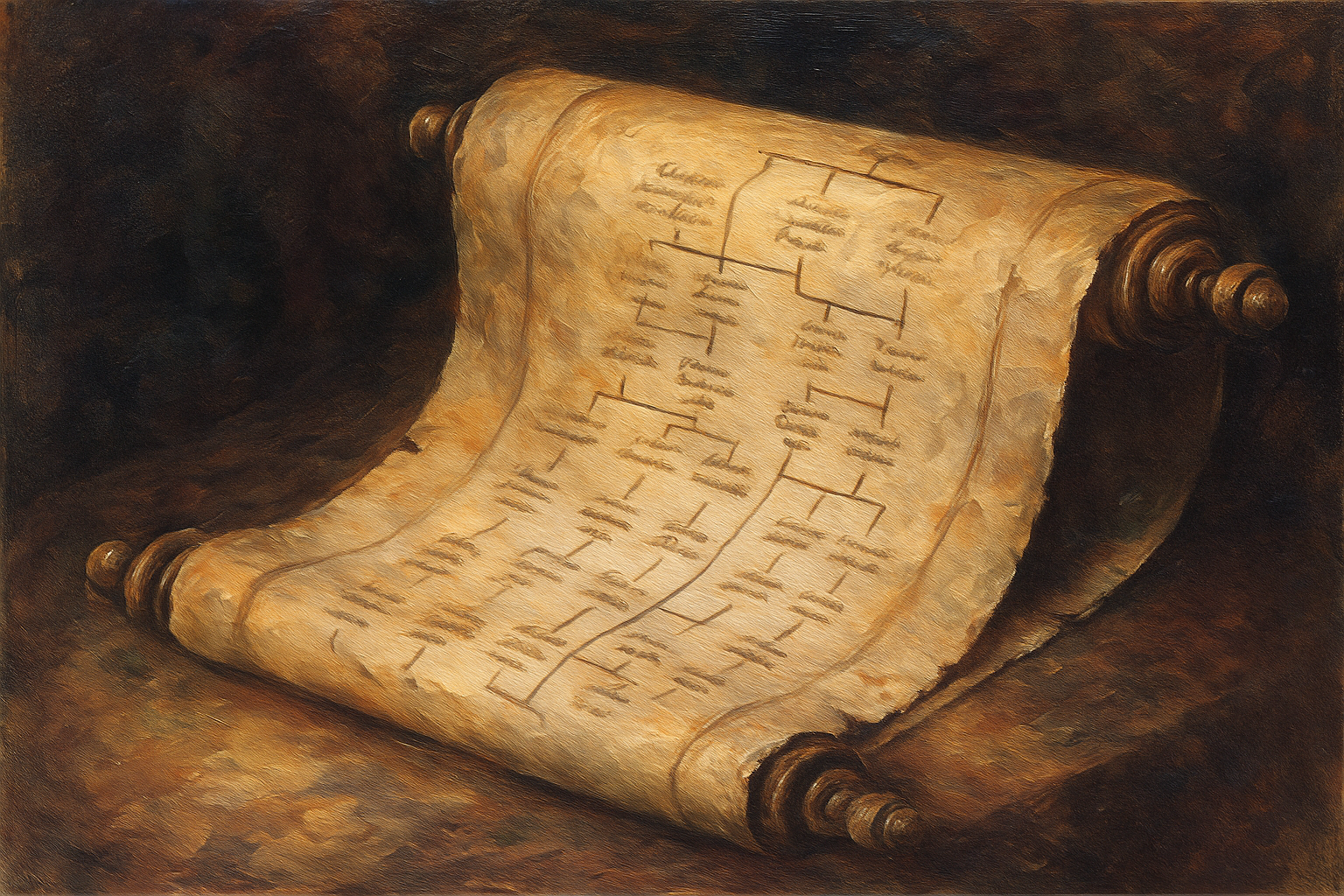
The book of Matthew opens with a genealogy that stretches across centuries, for the birth of Christ is set within the long covenant history of Israel, and this record of names is more than ancestry, because it is a testimony that God’s promises remain intact. Each generation links the story of Jesus to the story of Abraham, to the throne of David, and to the people who endured exile, for the God who calls, establishes, and restores has bound His purposes to a royal line. The names are not random markers of time but covenant milestones, and through them the Lord shows that His plan has never faltered and His promise has never been broken.
The genealogy begins with Abraham, to whom God swore that through his seed all nations would be blessed, and it moves deliberately through Isaac, Jacob, and Judah, the forefather of the royal tribe (Matthew 1:2). It advances to David, the king who received the promise of an everlasting throne (Matthew 1:6), and it continues through Solomon and the line of kings that followed him. Even as the record turns toward Jeconiah and the exile to Babylon (Matthew 1:11), the covenant thread remains unbroken, because God’s word endures when crowns are lost and kingdoms collapse. The scroll presses forward through generations of obscurity until it arrives at Joseph, the husband of Mary, through whom the Messiah is introduced into history (Matthew 1:16).
The mention of exile here is no minor detail, for the people of Judah were carried away as a direct consequence of their covenant unfaithfulness, yet even judgment did not erase the line, and God did not shirk His covenant responsibility, because He had sworn that David’s house would stand before Him forever. If the Assyrians, who had already conquered the northern kingdom, had overtaken Judah as well, assimilation would have swallowed their identity, just as Israel’s ten tribes were scattered and absorbed among the nations (2 Kings 17:6). Instead, it was Babylon that came, and under Babylonian rule the people were preserved, disciplined but not dissolved, integrated into a foreign empire yet not erased as a covenant people. Even Jeconiah, the exiled king of Judah, was preserved by God’s mercy, for after years of imprisonment he was lifted up and granted honor in the court of Babylon’s successor (2 Kings 25:27–30). His survival bore witness that the royal seed remained intact and that the promise to David had not been abandoned, and Matthew’s genealogy deliberately carries us through that exile so that the birth of Christ is seen not as a break from the covenant story but as its continuation and fulfillment.
Yet the line is not only royal but also surprising, for the mention of Tamar, Rahab, Ruth, and the wife of Uriah stands out, because their stories remind us that God’s covenant mercy weaves through scandal, foreign bloodlines, and sorrow. Tamar bore Perez after deception had stained Judah’s house (Matthew 1:3), Rahab was a Canaanite woman in Jericho who clung to Israel’s God (Matthew 1:5), Ruth left Moab to walk in covenant faith (Matthew 1:5), and Bathsheba’s loss was turned toward the birth of Solomon (Matthew 1:6). Their names stand as proof that God redeems broken histories and grafts the outsider into the royal line, because His purposes never depend on human perfection but on His covenant faithfulness.
The genealogy closes with Christ, introduced not by human arrangement but by divine initiative, for Joseph, described as the husband of Mary, is drawn into the unfolding promise when an angel tells him that what is conceived in her is from the Holy Spirit and that the child shall be named Jesus, because He will save His people from their sins (Matthew 1:20–21). Matthew explains that this fulfills what was spoken through the prophet: a virgin shall conceive and bear a son, and His name shall be Immanuel, “God with us” (Matthew 1:22–23). Every name in the genealogy, every covenant given, and every generation preserved finds its meaning here, because the King’s line reaches its intended goal in Jesus the Christ (Matthew 1:17).
The line established in Matthew 1 is therefore proof that God never abandons His promises, for when Abraham’s descendants faltered, the covenant endured, and when David’s throne fell into ruin, the promise stood firm, and when exile scattered God’s people, the line remained unbroken. Even when judgment fell, God’s discipline was bound to His mercy, because He preserved the line of David through Babylonian captivity and ensured that the promise reached its fulfillment. The testimony of these names extends into our own stories, for God continues to redeem what is fractured and to uphold what He has declared, and the genealogy of Matthew 1 assures us that the King’s reign has been prepared from the beginning and that His covenant faithfulness remains the anchor of every generation, just as He declared through Isaiah that His word would accomplish all that He purposed (Isaiah 55:11) and through Jeremiah that His everlasting love would sustain His people through every season (Jeremiah 31:3).
Luke 2 – The Line Revealed
Luke’s Gospel draws us from the scroll of names into the scene of fulfillment, because the line long established in covenant history is now revealed in the birth of Christ. The chapter begins with Caesar’s decree that all the world should be registered, and this political order sets in motion a divine plan, for Joseph and Mary travel from Nazareth to Bethlehem, the city of David, where prophecy had declared the Messiah would be born (Luke 2:1–4; Micah 5:2). While emperors issue commands and rulers boast of their power, God directs history with precision, and the true King enters the world not in a palace but in a manger.
The simplicity of His birth underscores the contrast between heaven’s glory and earth’s expectations, for Mary gives birth to her firstborn son, wraps Him in swaddling cloths, and lays Him in a feeding trough because there is no room in the inn (Luke 2:7). This moment shows that the covenant promise does not arrive with human splendor but with humility, because the Lord who formed the heavens chooses to reveal His reign in obscurity. The shepherds watching their flocks by night are the first to receive this announcement, and an angel declares to them that a Savior has been born in the city of David, who is Christ the Lord (Luke 2:8–11). Suddenly the sky resounds with a multitude of heavenly hosts proclaiming, “Glory to God in the highest, and on earth peace among those with whom He is pleased” (Luke 2:14), and the news first entrusted to shepherds becomes the proof that God’s covenant word has reached its goal.
The shepherds hurry to Bethlehem and find Mary, Joseph, and the baby lying in the manger, and they return glorifying and praising God for what they had seen and heard (Luke 2:15–20). Mary, meanwhile, treasures these things and ponders them in her heart, because the covenant thread she has been swept into is greater than what she yet understands. When the child is presented in the temple, Simeon, a righteous and devout man awaiting the consolation of Israel, takes Him in his arms and blesses God, declaring that his eyes have seen the salvation prepared in the presence of all peoples, a light for revelation to the Gentiles and for glory to Israel (Luke 2:25–32; Isaiah 49:6). Simeon was a man whose hope had not dimmed through years of waiting, and his faith embodied the expectation that God’s promises to Israel would surely come to pass. Anna the prophetess, an elderly widow who worshiped day and night in the temple with fasting and prayer, joins in thanksgiving, speaking to all who were waiting for the redemption of Jerusalem (Luke 2:36–38). The covenant line is therefore not only preserved but publicly revealed, because the promises entrusted to Israel now stand embodied in Christ.
The chapter closes with a glimpse of Jesus in His youth, as His parents take Him to Jerusalem for the Passover. When He lingers in the temple at twelve years old, sitting among the teachers and astounding them with His understanding, Mary and Joseph find Him after searching anxiously. His response—“Did you not know that I must be in my Father’s house?” (Luke 2:49)—reveals that His mission is already set toward the will of God, because the King who was promised in covenant and revealed in humility now grows in wisdom and stature and in favor with God and man (Luke 2:52).
The line revealed in Luke 2 is therefore the fulfillment of promises that had stretched across generations. The covenant sworn to Abraham, the throne promised to David, and the hope preserved through exile all find their answer in Christ, because His birth proves that God has not abandoned His people. The shepherds’ song, Simeon’s blessing, and Anna’s thanksgiving echo the faith of prophets who longed for this moment, and the manger in Bethlehem stands as evidence that the God of Israel has revealed His covenant King. For us, this chapter assures that every promise spoken in the past holds its fulfillment in the present, and every hope anchored in covenant faith finds its reality in Christ. Just as Isaiah foretold that the people walking in darkness would see a great light (Isaiah 9:2), and just as Micah declared that from Bethlehem would come forth the ruler of Israel (Micah 5:2), so Luke testifies that the line once established is now revealed, because the King has come to dwell with His people.
Final Reflection
The Gospel does not begin with a break from the past but with the seamless continuation of covenant history, because the promises given to Abraham and David, preserved through exile and through the long silence when no prophet spoke, find their fulfillment in Jesus. The genealogy of Matthew reminds us that God never abandoned His word, and the nativity of Luke shows us that His word arrived in flesh and blood. From patriarchs to prophets, from exile to expectation, the covenant thread has never unraveled, and the King’s line has never failed. For us, this truth anchors faith in the God who disciplines without destroying, who preserves even through judgment, and who reveals His glory in ways the world least expects.
Prayer
Lord,
We praise You for the covenant faithfulness that remained steadfast from Abraham to David, from exile to Bethlehem, and from promise to fulfillment. Teach us to trust that Your word does not falter, and remind us that the reign of Christ is the proof that every promise You have spoken will stand. May our hearts continually rejoice because we have seen Your salvation revealed in Jesus.
In Jesus’ name,
Amen.
Journaling Prompt
Where in your life do you carry the ache of loss or the memory of failure, and how does the King’s line remind you that God’s promises remain steadfast and that His covenant purposes will always reach their fulfillment?
In Christ,
Mrs. O 🤍





Leave a Reply