
Scripture Reading: 1 Samuel 28–31; Psalm 18
Light does not always travel in a straight line. When it passes through glass or water, it bends—split into colors, scattered into fragments, refracted in ways the eye cannot always trace. So too with our stories. What begins in clarity can fracture under pressure and what once shone bright may flicker through grief, fear, or failure. Yet—even broken light still points back to God.
In the final chapters of 1 Samuel, the light of Israel’s story seems to bend away from its original promise. Saul, once anointed with divine favor, descends steadily into spiritual darkness. David, once called and consecrated, inches dangerously close to compromise as he seeks shelter among the Philistines. The town of Ziklag is left in smoldering ruins, and the slopes of Gilboa are stained with royal blood. Yet even as the beams of hope scatter—some swallowed by shadow, others softened by mercy—the presence of God does not falter. He remains unmoved by chaos, unchanged by failure, and ever near to those who call on His name.
By the time David lifts his voice in Psalm 18, the fragments no longer feel random. He sees with Spirit-born clarity: every cry, every battle, every wilderness moment refracted the glory of the One who sustained him.
These chapters do not tell the story of perfect people walking in perfect light. Rather, they tell the story of fractured journeys faithfully lit by the unwavering light of God.
Shattered Lenses (1 Samuel 28)
Saul’s descent did not begin in the darkness of Endor; it began in the slow erosion of obedience. Though he was once chosen by God and anointed to lead Israel, time and repeated compromise dulled the vision he had been given. The man who had once stood tall in both stature and spirit now finds himself crouching in fear—cloaked not only in disguise, but in desperation.
By this point, Samuel—the prophet who once counseled him—is dead, and Israel has already mourned his passing. The Philistine army is advancing. And the silence of God looms heavy. No dreams are given, no prophets speak, no answers come. Desperate for direction, Saul takes a tragic step backward. He disguises himself and travels by night to consult a medium in Endor—turning to the very practice he had once condemned. “Saul had expelled the mediums and spiritists from the land” (1 Samuel 28:3), a decision once rooted in reverence for the Lord’s command. But now, the voice of the Lord is silent, and Saul seeks light in a forbidden shadow.
The scene is shrouded in darkness, both literal and spiritual. Startled by what she sees, the woman conjures a vision of Samuel. When Saul hears the prophet’s voice, he collapses—physically and emotionally undone. But what he receives is not reassurance. It is confirmation. “The Lord has turned from you and become your enemy… because you did not obey the voice of the Lord” (1 Samuel 28:16–18). Whether divinely permitted or supernaturally echoed, the message is unchanged. There is no new revelation—only the echo of what Saul had already been told, time and again.
This is what it means for the lens to shatter. Saul can no longer see clearly—not his identity, not his future, and not his God. His fear becomes a filter, and through it, even light is distorted into shadow. When we step beyond the boundaries of obedience, we risk refracting truth into confusion. As Isaiah warned, “Should not a people inquire of their God? Why consult the dead on behalf of the living?” (Isaiah 8:19).
Prisms of Faith (1 Samuel 29)
While Saul spirals deeper into the shadows, David finds himself caught in a very different tension—one where the light is present, but bent. For over a year, David has been living among the Philistines, having fled from Saul’s relentless pursuit. Seeking refuge under King Achish of Gath, David has walked a precarious line: outwardly aligning with Israel’s enemies while secretly raiding their allies. He has built a life in Ziklag, a Philistine town, but his heart has never belonged there.
Now, as the Philistines prepare to go to war against Israel, David faces an impossible moment. He and his men are summoned to join the battle—a battle that would have David raising his sword against his own people, against the covenant nation he was anointed to one day lead.
As David marches alongside Achish, the other Philistine commanders raise their objections. They remember his songs—“Saul has slain his thousands, and David his tens of thousands” (1 Samuel 29:5)—and they do not trust him. Achish defends David’s loyalty, but in the end, the commanders prevail. David is sent back, dismissed from the ranks with what sounds like honor, but feels more like divine interruption.
This moment reads like a refraction—a light beam split through circumstance. On the surface, it appears David is ready to fight for the wrong side. But beneath that appearance, God is sovereignly protecting His servant from a battle he was never meant to fight. David turns back toward Ziklag, unaware that devastation awaits. But even that return is a mercy. God was not finished shaping him, and though his decisions in Philistia were shaded by fear and compromise, they were not beyond the reach of grace.
Sometimes faith doesn’t move in a straight line. It passes through complicated decisions, mixed motives, and seasons where everything feels unclear. And yet, even in those moments, God continues to lead. As Paul later wrote, “If we are faithless, He remains faithful—for He cannot deny Himself” (2 Timothy 2:13). Even when our trust wavers, the mercy of God continues to shine through the prism of our limitations.
Fractured Beams (1 Samuel 30)
The road back to Ziklag stretches long beneath David’s feet, a dust-covered path that carries more assumptions than questions. After being dismissed from the Philistine battle lines, David returns with six hundred of his men to the town they have called home during exile—a place of uneasy peace, but peace nonetheless. Yet as they near the ridge overlooking the settlement, the illusion begins to crack.
Ziklag is gone!
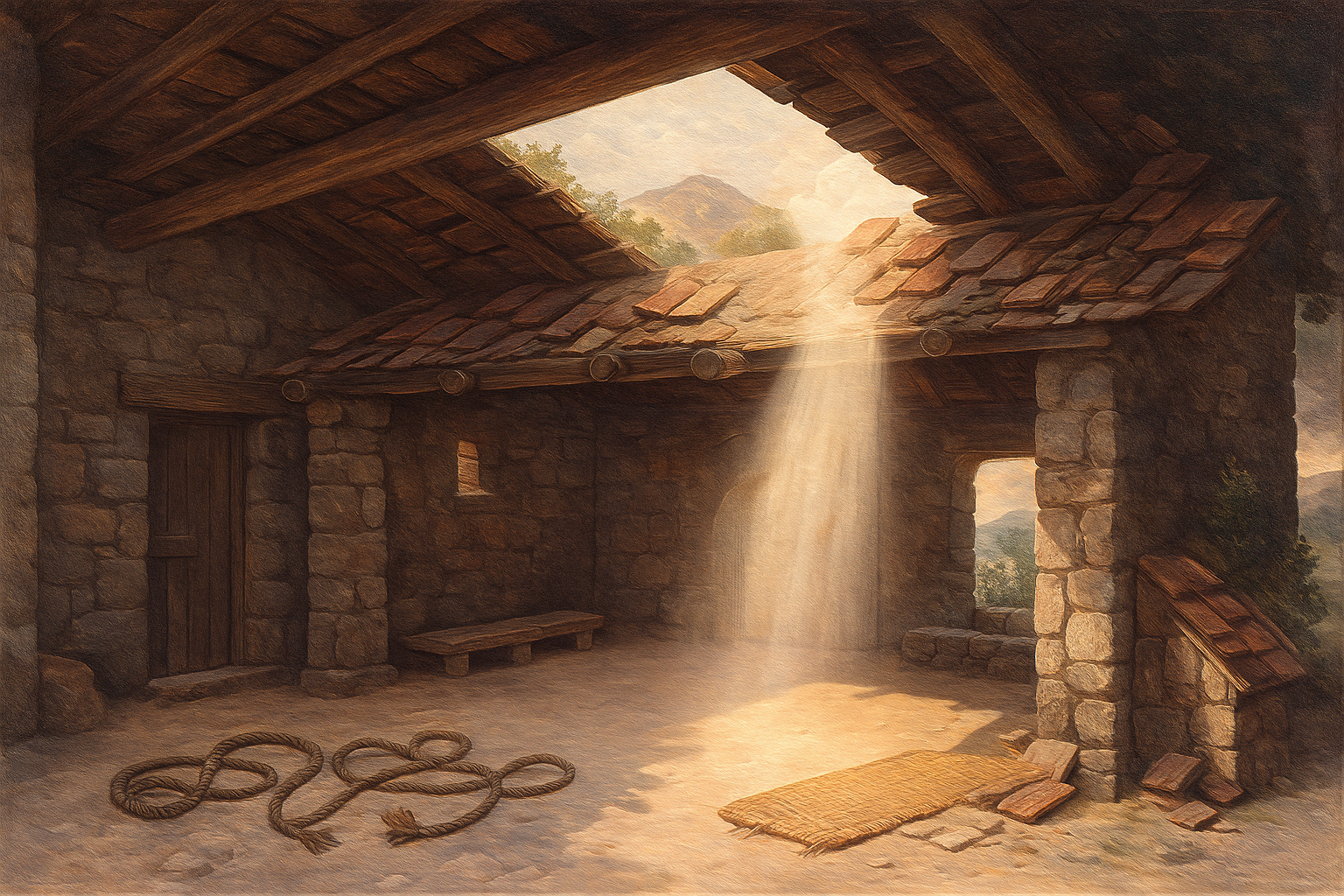
Smoke rises from scorched ruins. The Amalekites have struck in David’s absence, burning the city and carrying off every woman and child. There are no bodies—only the haunting absence of life. In that moment, the beams that once supported David’s world splinter under the weight of devastation.
The men who had followed him into caves and battles, who had pledged loyalty through hunger and hardship, now turn on him in grief. “They wept until they had no strength left to weep” (1 Samuel 30:4), and their sorrow curdles into rage. They even spoke of stoning him.
Yet it is in this shattered place that something radiant begins to rise. David does not defend himself, argue his case, or spiral into despair. Instead, he “strengthens himself in the Lord his God” (1 Samuel 30:6). This is no hurried prayer or hollow ritual—it is a deliberate return. A re-centering of his heart and vision on the One who had never abandoned him. He calls for the ephod, the sacred garment used to seek God’s guidance, and he inquires—not simply whether to act, but whether hope still remains.
God’s response is clear and commanding: “Pursue, for you shall surely overtake and shall surely rescue” (1 Samuel 30:8).
Emboldened by this divine assurance, David gathers his men and sets out. Along the way, they encounter a discarded Egyptian servant, left behind by the Amalekites. David pauses, not just to question him, but to feed and restore him—an act of mercy that becomes the key to finding the enemy’s camp. In the end, David not only recovers every captive, but also takes back more than was lost. “Nothing was missing… David brought back all” (1 Samuel 30:19).
God’s most powerful deliverance often begins at the very point of collapse. When the structures we trusted can no longer hold us, and the beams beneath our feet give way, He does not let us fall beyond His grasp. In Christ, even the wreckage of our lives can be rebuilt—not in haste, but in holy strength. “He gives strength to the weary and increases the power of the weak” (Isaiah 40:29).
And when we rise—carried by His mercy rather than our own might—we do not return merely to what was. We rise into something greater: trust renewed, faith deepened, and a calling restored, not in spite of the breaking, but because of it.
Scattered Rays (1 Samuel 31)
The final battle unfolds on the slopes of Mount Gilboa, but the war within Saul had begun long before swords were drawn. Though once anointed and filled with promise, he now stands fractured and fatigued, burdened by a kingdom he was never meant to sustain in his own strength. As the Philistine forces close in, his sons fall beside him—including Jonathan, the faithful warrior who had once bound his soul to David in covenant love. Wounded and unwilling to be captured, Saul falls on his own sword. His armor-bearer, overcome with grief, follows him in death.
The light of Israel’s first king does not fade in triumph—it flickers out in tragedy. The enemy finds their fallen foes and, reveling in conquest, desecrates the bodies. Saul and his sons are hung on the walls of Beth-shan, their names now exposed to shame rather than glory.
And yet, Saul’s downfall did not begin on this battlefield. His story began with such holy potential—marked by royal stature, prophetic blessing, and the Spirit of the Lord resting upon him. But over time, the light that once marked his calling began to bend. Fear clouded his discernment. Pride hardened his heart and disobedience drew him away from God. What might have burned with brilliance instead scattered into dying embers, never fully gathering into a flame of lasting legacy.
Still, even in the debris of failure, dignity flickers through. The men of Jabesh-gilead—those Saul once rescued in the early days of his reign (1 Samuel 11:1–11)—remember the courage that once defined him. Under the cover of night, they risk everything to retrieve the fallen bodies. With honor, they burn and bury the bones beneath a tamarisk tree, preserving what they can of the man Saul once was.
This is often how legacy lingers—not in fireworks, but in fragments. Not in the noise of conquest, but in the quiet loyalty of those who still remember. Saul’s story reminds us that leadership without surrender diffuses the light rather than reflecting the glory of God. “If the light within you is darkness, how great is that darkness” (Matthew 6:23).
Spectrum of God’s Glory (Psalm 18)
By the time David lifts his pen to compose Psalm 18, the weight of years has settled into something richer than memory—it has become wisdom. The chases through wilderness, the betrayals and narrow escapes, the long nights in caves, and the low whispers of fear have all left their imprint. He has stumbled through valleys where the light barely reached. He has cried out in dark places where even hope felt hollow. And yet, now—standing on the far side of deliverance—he looks back, and the scattered pieces no longer feel random. What once seemed chaotic has revealed itself as glory refracted through every trial. He sees not just survival, but splendor—in full spectrum!
“I love You, O Lord, my strength. The Lord is my rock and my fortress and my deliverer…” (Psalm 18:1–2). These are not poetic flourishes written from the safety of distance. They are declarations shaped by experience. Caves could not shield him and strongholds could not secure him. Only the hand of God preserved his life and when the cords of death wrapped tightly around him, David cried out—and “He heard my voice… then the earth reeled and rocked” (Psalm 18:6–7). Heaven moved because God answered.
This is the miracle of grace—that the God who thunders from the heavens and commands the lightning takes joy in dwelling with the humble and contrite. He chose a man who faltered, fled, and failed—but also a man who returned. David was not flawless, but he yielded and in that surrender, God found a vessel fit to carry His beauty.
The entire psalm moves steadily toward one luminous conclusion: every moment—whether marked by fear or favor—became a prism through which the character of God came into view (Psalm 18:28). The light David carried was never of his own making. It was the flame of God—kindled in hidden places, preserved through storm and sorrow, and made visible through surrender.
In the end, it is not David’s strength or strategy that shines most brightly. It is the glory of God—radiating through him, unhindered by failure, unwavering in presence, and undiminished in power. “The Lord lives, and blessed be my rock, and exalted be the God of my salvation!” (Psalm 18:46).
Reflection
The story of refracted light is not one of brightness lost—it is the story of light intentionally redirected. Through shattered lenses, bent prisms, fractured beams, and scattered rays, we witness lives tested by fear, humbled through failure, and ultimately reclaimed by grace. Saul’s story ends in darkness, his disobedience diffusing the very calling he had once carried with promise.
David’s journey, by contrast, though winding and imperfect, bends steadily back toward the light of God. We see it in Ziklag, where despair is met with divine strength. We see it in the wilderness, where silence and uncertainty become the sacred training ground of trust. We also see it in Psalm 18, where every fractured moment, every flicker of deliverance, converges into one radiant truth: God had never withdrawn. He was always present—redirecting, restoring, and revealing His glory through every fragment.
There may be moments when life feels fractured—when fear clouds your vision or failure makes the path forward difficult to discern. And yet, refracted light is still light. When it comes from God, it does not dim or disappear. Even when its course bends through sorrow or weaves around uncertainty, it still carries the steady presence of the One who guides with grace.
In Christ, all that feels scattered finds its place. The cross, at first glance, appeared fragmented—marked by betrayal, silence, darkness, and death. But through the resurrection, we come to see it clearly: the full spectrum of God’s justice and mercy burning bright with redeeming love. “In Him was life, and that life was the light of men. The light shines in the darkness, and the darkness has not overcome it” (John 1:4–5).
Prayer
Lord,
When my sight is dimmed by fear, failure, or silence, remind me that Your light still shines. Refocus my heart through the lens of truth. Where beams have fractured, heal them with mercy. Where shadows linger, speak light. And as I trace each ray, let it lead me back to You—my Rock, my Redeemer, and the Source of all glory.
In Jesus’ name,
Amen.
Our Scripture reading schedule for the rest of the week:
| Day | Date | Scripture Reading |
| Sunday | April 20 | Ps. 121-125, 128-130 |
In Christ,
Mrs. O 🤍



Leave a Reply