Scripture Reading: Judges 10-12
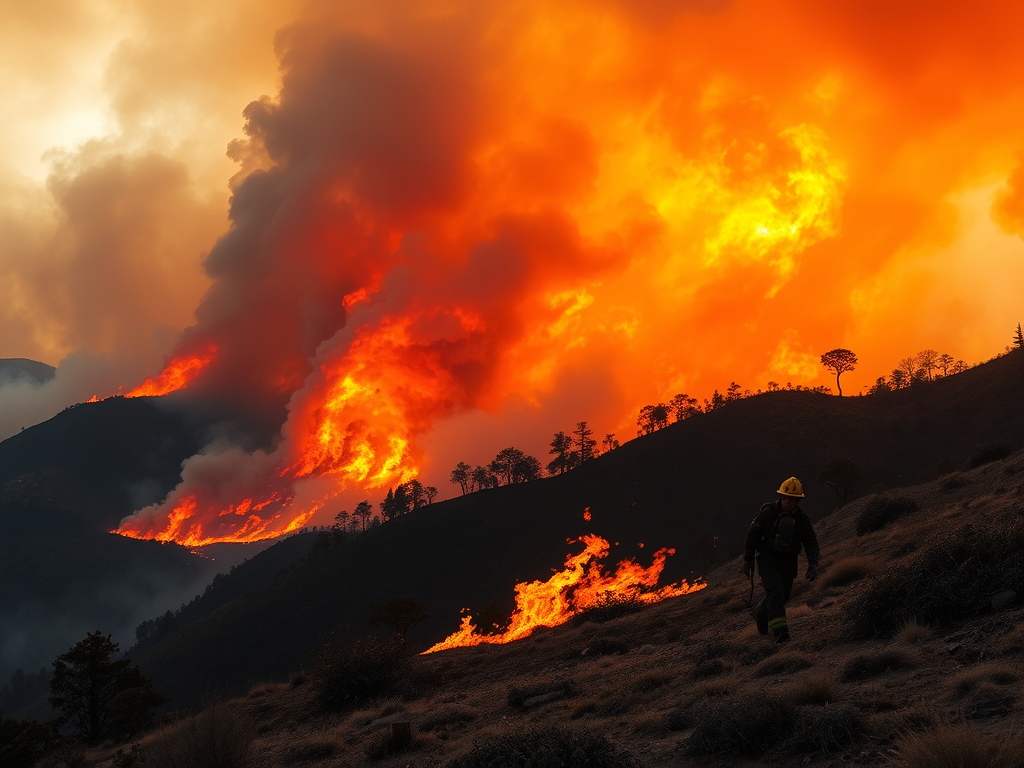
In January 2025, Southern California faced a series of devastating wildfires that profoundly impacted the region. The Palisades Fire, igniting in the Santa Monica Mountains, rapidly spread to engulf over 23,000 acres, leading to mass evacuations and significant property loss. Simultaneously, the Eaton Fire erupted in the San Gabriel Mountains’ Eaton Canyon, devastating communities like Altadena by consuming more than 14,000 acres and resulting in the loss of numerous homes and lives. Additionally, the Hurst Fire in Sylmar burned approximately 799 acres, prompting further evacuations and destruction. These fires, fueled by severe drought conditions and powerful Santa Ana winds, underscored the region’s vulnerability to rapid and widespread devastation. As we reflect on those days, we remember the heroic emergency teams and firefighters who battled the flames, and we honor those who suffered loss in the midst of the crisis!
In Judges 10–12, the imagery of wildfire serves as a poignant metaphor for Israel’s spiritual state during that period. Much like a parched landscape susceptible to ignition, the Israelites’ hearts were dry and brittle from repeated cycles of disobedience and idolatry. This spiritual aridity made them vulnerable to the consuming fires of oppression and internal strife. In these chapters, we encounter leaders who, like firefighters, emerged to deliver Israel and restore peace, albeit temporarily. Some, such as Tola and Jair, provided stability and containment, akin to controlled burns that prevent larger disasters. Others, like Jephthah, had a more tumultuous impact—achieving deliverance but at a significant personal and communal cost. Their stories underscore how unchecked impulses and rash decisions can ignite devastation, while wise and humble leadership can help extinguish the flames of chaos.
Wildfire-prone (Judges 10)
The narrative opens with two brief reigns that seem like dew on dry ground—gentle, quiet, and momentarily refreshing. Tola, from the tribe of Issachar, judged Israel for twenty-three years. Jair followed, reigning for twenty-two years and fathering thirty sons who rode thirty donkeys and oversaw thirty towns (Judges 10:1–5). These two men led during an era of relative peace, and while their leadership lacked dramatic flair, their presence was a mercy from God—a pause before another storm. Their stories, though brief, signal what stability can look like in a spiritually dry land.
But the peace was shallow. Beneath the surface, the land was brittle with compromise, and soon the flames of rebellion reignited. Israel once again did evil in the sight of the Lord, not simply by wandering off course but by plunging into full-blown idolatry. They served the Baals and Ashtoreths, as well as the gods of Aram, Sidon, Moab, Ammon, and the Philistines—a comprehensive list that signaled total spiritual disintegration (Judges 10:6). In response, God allowed these surrounding nations to oppress Israel, and for eighteen years they were crushed—especially those living across the Jordan. The once-stable landscape was now overrun with judgment!
When Israel cried out, God’s reply revealed the depth of their betrayal. “Go and cry out to the gods you have chosen. Let them save you when you are in trouble!” (Judges 10:14). And yet, even as He gave them over to the consequences of their choices, when the people put away their idols and returned to the Lord, His heart stirred. The text says, “He could bear Israel’s misery no longer” (Judges 10:16). This is the tenderness of a holy God who disciplines in righteousness yet remains rich in compassion.
Often, we don’t recognize the early signs of spiritual drought until we’re surrounded by smoke. But true repentance, like rain on scorched ground, changes everything. Godly sorrow produces a change of heart and direction that leads to life, not regret—because His mercy meets us not at the edge of perfection, but in the honest place of surrender (2 Corinthians 7:10).
A Wildfire of Mixed Results (Judges 11)
Jephthah’s story begins on the margins—cast out because of his mother’s status, rejected by his brothers, and driven to the land of Tob where he gathered a rough band of followers (Judges 11:1–3). He lived among outcasts, far from power, until desperation changed everything. When the Ammonites threatened Gilead, the elders turned to the very man they had once disowned. They pleaded with Jephthah to lead them into battle, and he agreed—if they would truly make him their leader. Their urgency opened the door for his redemption, and Jephthah stepped into his calling not with arrogance, but with measured resolve.
Before raising a sword, he tried diplomacy. Jephthah sent messengers to the king of Ammon, recounting Israel’s journey and God’s faithfulness with striking precision (Judges 11:12–27). He was a warrior with a historian’s memory and a heart that sought resolution. But when diplomacy failed, the Spirit of the Lord came upon him (Judges 11:29). He passed through the land, rallying troops and preparing for what would become a pivotal victory.
And then came the vow!
Before the battle, Jephthah promised that if the Lord gave him victory, he would offer as a burnt offering whatever came out of his house to greet him (Judges 11:30–31). It was a vow born not from divine instruction but from human insecurity—an attempt to secure what God had already promised.
The victory was decisive. But as Jephthah returned, it was his only child—his daughter—who came out to meet him with joy. The tension of the text tightens here. The girl, unnamed yet radiant in loyalty, responded with surrender: “My father… you have given your word to the Lord. Do to me just as you promised” (Judges 11:36). Whether she was offered as a burnt sacrifice or devoted to a life of celibacy and service, the cost was irreversible.
There’s a sobering lesson here. Sometimes, in our zeal, we make promises God never asked for. We try to bargain with a God who operates by grace. But even in the wreckage of our missteps, His presence remains steady. He doesn’t always rescue us from the consequences—but He walks with us through them. And in those places, we learn that His grace is not a transaction—it is sufficient, even when our own wisdom fails (see 2 Corinthians 12:9).
Destruction and Dimming Embers (Judges 12)
Jephthah’s story, rather than ending in peace, transitions into bitter division. The Ephraimites, offended that they had not been called to battle against Ammon, confronted Jephthah with sharp words and sharp swords. What could have been a shared celebration became civil war. Jephthah’s men from Gilead fought fiercely, capturing the fords of the Jordan and identifying fugitives through a linguistic test. Those who failed to pronounce “Shibboleth” correctly were executed on the spot (Judges 12:5–6). Forty-two thousand Ephraimites died—not at the hands of foreign enemies, but by their own brothers!
Jephthah judged Israel for only six years before his death. His legacy—marked by deliverance, division, and sorrow—faded into the soil.
What followed was a quieter series of leaders—men we know only in fragments. Ibzan of Bethlehem had thirty sons and thirty daughters, building alliances through marriage (Judges 12:8–10). Elon, of the tribe of Zebulun, judged for ten years, though the Scripture gives no detail beyond his name and place of burial (Judges 12:11–12). Then came Abdon, who led for eight years. He had forty sons and thirty grandsons who rode seventy donkeys—a sign of prosperity and tribal prominence (Judges 12:13–15).
Their reigns didn’t shake nations, but they still mattered. Sometimes God raises up peacemakers whose strength is measured not in wars won, but in stability maintained. Their stories may not echo like Jephthah’s, but they still formed part of the tapestry God was weaving.
In seasons when your faithfulness feels quiet or unseen, take heart. Your labor in the Lord is never wasted, no matter how small it seems and when our fire dims, He fans it back to life with grace (1 Corinthians 15:58).
Reflection
Wildfires don’t ask permission. They move fast, fueled by the smallest spark and a wind strong enough to push destruction forward. And yet, after the smoke clears, the landscape is never the same. In some cases, new life eventually returns—green shoots pushing up through blackened soil. But in others, the scars linger, telling stories of what was lost.
Judges 10–12 is a stretch of scorched history—where faith flared, faltered, and flickered again. Some leaders offered stability while others brought devastation. Yet through it all, God remained present. He heard the cries of the repentant and He raised up judges in their weakness. His hand quietly shaped a people destined for more than what they could see.
These chapters remind us that faithfulness doesn’t always look extraordinary. Sometimes it means showing up when no one notices—like Tola, Elon, or Abdon. Other times, it means trusting God’s plan even when our past disqualifies us in the eyes of others, as Jephthah’s story shows. All in all, nothing offered in obedience to God is ever wasted (Hebrews 6:10).
Prayer
Lord,
You see the dry places in me—those moments where I’ve chosen idols over intimacy, control over trust, or hasty words over quiet surrender. I ask You to soften my heart, to meet me not just in the flames but in the ashes that remain. Teach me to lead with humility, to follow with consistency, and to speak only what You’ve spoken. In seasons of quiet service or moments of fierce trial, help me to remember that You are the One who sees and who restores.
In Jesus’ name,
Amen.
Our Scripture reading schedule for the rest of the week:
| Day | Date | Scripture Reading |
|---|---|---|
| Friday | April 4 | Judges 13-15 |
| Saturday | April 5 | Judges 16-18 |
| Sunday | April 6 | Judges 19-21 |
In Christ,
Mrs. O 🤍



Leave a Reply